What do you think about when you have nothing to think about?
When your body is busy, washing the dishes or driving an easy road or waiting to fall asleep or doing some other thing that doesn’t require you to use much of your conscious thought – what do you think about?
From my earliest memory of thinking about anything, I made up stories inside my head.
When I was quite small, this took the form of playing. We weren’t allowed actual dolls, but I made up stories with my paper dolls and Lego people or acted them out with my own body. This is fairly normal little girl behavior.
As I got a bit older, I started writing stories instead of acting them out. And pretty much anytime I needed something to think about, I would think about the stories I was writing – what would happen next, or backstories for my characters, or ideas for scenes that would happen in the future, or lines that I wanted to work into some story somewhere.
Through my teen years, my stories were my happy place – sometimes my only happy place. I made up stories with no agenda, no plan to do anything with them later – except to read them because I enjoyed doing that. I thought that it would be incredible to publish a book, but I also thought that it was an impossible thing for a little Mennonite girl like me to do – because I didn’t make up Mennonite stories. So I made up stories for myself – for the fun of it, and also as a way to deal with the bone-deep loneliness that filled most of my teen years.
I got married and moved a thousand miles away, and I kept on making up stories. I found the cure for my bone-deep loneliness, and I kept on making up stories. I got my first job in the field of accounting and discovered a whole new world that I was violently interested in even though I had been convinced I wouldn’t be, and I kept on making up stories.
But not quite as much as I used to.
A little over two years after we’d gotten married, we moved states, and two summers later, the little Mennonite girl poured kerosene across the boxes in the house of her mind that were labeled “Absolute & Unquestionable” and “Just To Be Safe” and “Gospel Truth (According to Certain Interpretations)” – and then she tossed a match. The fire was wild, and some things burned that I had not expected to. Yet I’ve never regretted any of it. My commitment was and is to truth, not to getting rid of Mennonite-ism, and I knew from the beginning that meant everything was up for questioning.
Not everything burned. Some things were made of gold, and some things were made of iron, and they survived the fire. But it took time to sift through the ashes and find those things, and it took more time to find new things to replace the ones that had been burned so that I could build a new house to live in.
This meant that I no longer had time with nothing to think about. I had so many things to think about and figure out. So many beliefs to question and test. So many questions to find answers to. So many thoughts to debate and dissect.
And I forgot to make up stories.
A year later, I took the work that I was doing and called it a bookkeeping business. And it began to be one. This changed my life in various ways, but the relevant one for this moment is that running a business takes far more thought than simply working in someone else’s business – and so I had something else that often needed thinking about during the times when I used to have nothing to think about.
I don’t know when I stopped writing my stories. I know that at some point in that year I wrote a couple short stories, and in the following year I turned the first draft of my book into the second draft, which meant a lot of editing and rewriting. But it wasn’t what I thought about most of the time.
The house of my mind was taking shape again, and it was a place I was happy to live in. The endless inquisition was finally quieting down. I could think about other things. But for some reason, I didn’t pick up my stories. Instead, what I thought about when I had nothing to think about was plans and to do lists. I had built a life that I enjoyed living, and between my relationships and my work and my growth goals, I found enough to keep my mind busy.
The year after that, which was last year, I gave birth to my first child. I don’t know if I wrote a single line of story that year. Pregnancy and preparing for life after a baby added to the list of things I could strategize about in my head, and my mental tracks continued to be mostly focused on plans and tasks, with the occasional regression into debating beliefs.
I never decided to stop writing. But I wasn’t completely unaware that I was doing it, and I accepted it. There were other things that were more important to me. Some of that was figuring out what I believe to be true, and some of it was integrating a side of my personality that I had previously squashed down into a little ball, and then a large bit of it was becoming mother.
But I always expected to come back to it – I always thought I would start making up stories again. And this year I started missing it, so I thought, “It’s time.”
But when I tried writing again everything felt extraordinarily stupid and mechanical and dull.
Here’s a question I never asked when I was constantly making up stories: “Where did I get my ideas?”
But I did ask it this year, because wherever that place was, I seemed to have lost my key. I found myself timid in my writing in a way I had never been before. With some effort I could force myself to sit down and start a story, but soon I found myself writing in small and increasingly dull circles, like I was afraid to commit to any direction and follow through – or like I couldn’t see any directions to commit to. I reread what I’d written and edited it in a nitpicky manner and stared blankly at the blank wall in my mind and was a little relieved when my baby daughter demanded my attention.
“This used to be so easy, this used to be so fun,” I mourned to my husband.
I analyzed all the reasons why something that had come so easy to my twelve-year-old self would be so difficult for adult me. I was afraid that I had killed my artistic side with logic and control. I was afraid that I had killed my artistic side with happiness and contentment. I was afraid that because I now wanted to and planned to publish a book, I had ruined my ability to make up stories for fun because I was trying to make up stories that were good. I told myself to shut up and go write, because there’s really only one thing that decides whether a person is a writer or not.
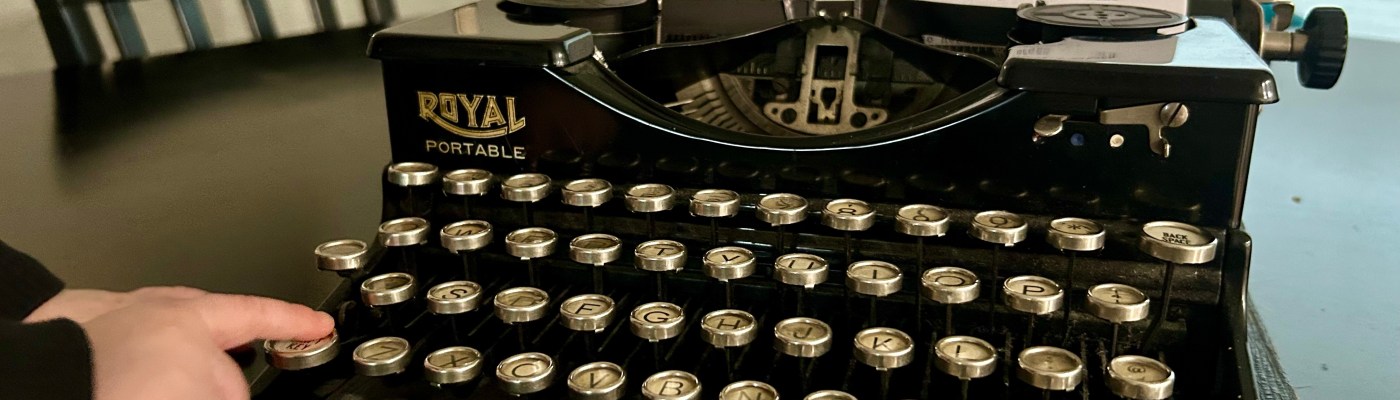
I tried writing a story about losing stories. I tried writing by hand so I couldn’t go back and edit it. I tried writing on my old manual typewriter so I really couldn’t go back and edit it. That worked, a little. But everything still tasted dry and bland.
But I kept trying. Part of the reason I wrote the Plastic Piano Sonnet was to exercise my writing muscles in a new way. I wrote a rough draft of a poem about how my stories had left me – or did I leave them? I read a delicious book On Writing, which made me hungry to write like that again. I read a Stephen King novel for the first time, which I found a bit creepy but also masterfully put together, and it reminded me once again how much I adore story as an art form.
And then a miraculous thing happened, the other day as I was driving home on Louisiana Street, just as I passed the little building the railroad company owns: a line from the song I was listening to sparked an actual idea for a story.
I wanted to ring joy bells out the window. I still do, which is why I’m telling you about it.
I have an idea for a story.
I haven’t written a word of it. But I’ve been thinking about it. While I do the dishes, when I’m driving, at night when I’m waiting to fall asleep.
I’ve been thinking about the story I found.
 JennStory
I love this so much! I am dying to know what the story is🥹I can’t wait to hear more❤️
LikeLiked by 1 person